A Palatial Beginning on the Golden Mile
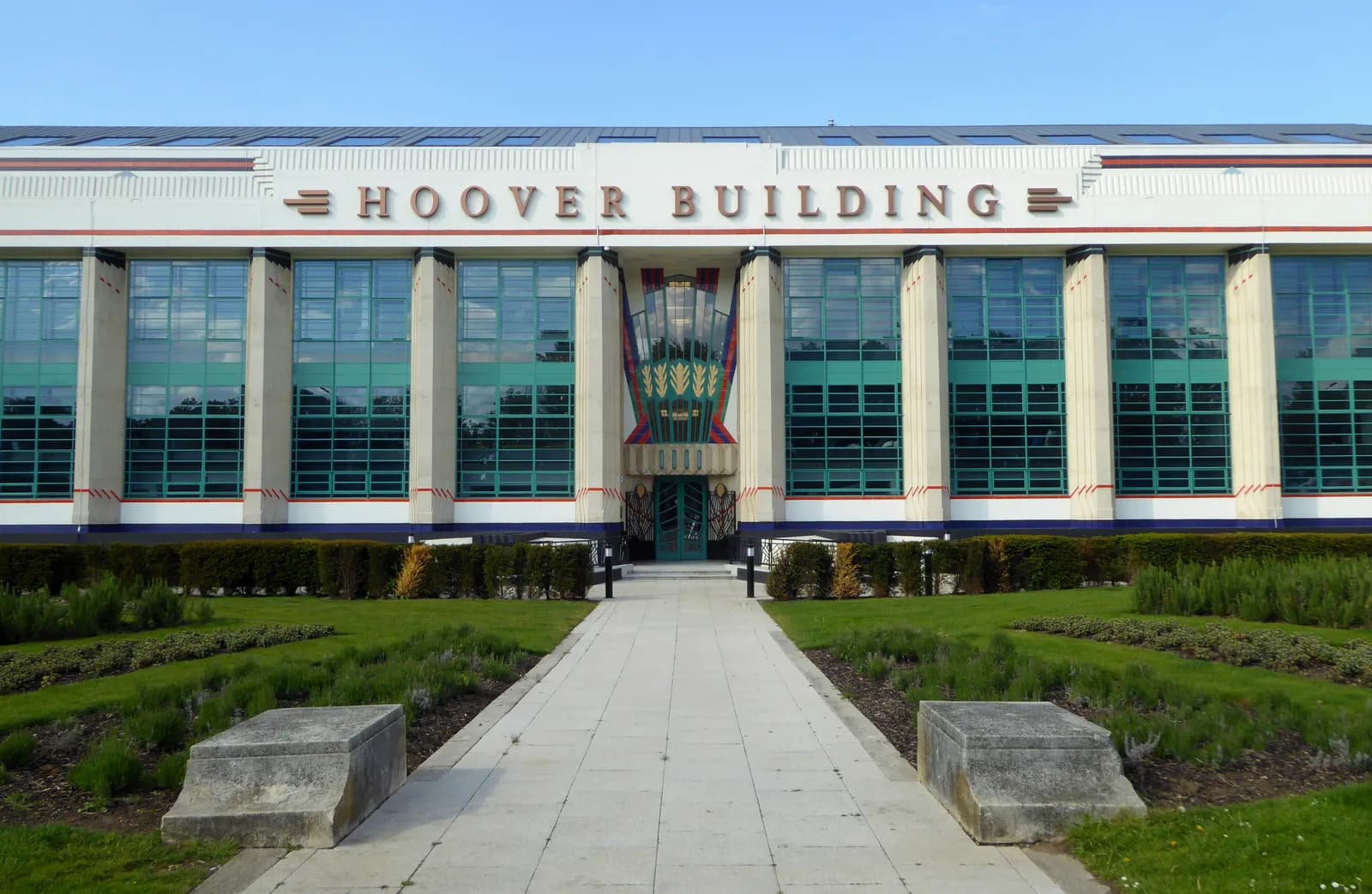
The Hoover Building stands as Ealing's most celebrated piece of industrial architecture, a gleaming white Art Deco palace that has dominated the A40 Western Avenue for over ninety years. Constructed between 1931 and 1933, the building opened on 2 May 1933 when Lord Rochdale unveiled what the press dubbed a "Modern Palace of Industry."
Architectural practice Wallis, Gilbert and Partners designed the factory for The Hoover Company, creating a statement of American corporate confidence during an era when Western Avenue was becoming London's "Golden Mile" of manufacturing. The firm employed Egyptian Art Deco motifs with Aztec and Mayan influences drawn from the 1925 Paris Exhibition, producing a grand façade of white "Snowcrete" concrete, triple-height Crittall steel windows, and a dramatic geometric sunburst pattern beneath the Hoover Limited lettering.
The building's designer, Thomas Wallis, believed that "a little money spent in the incorporation of some form of decoration, especially colour, is not money wasted. It has a psychological effect on the worker." The result was a structure that poet John Betjeman described as "a sort of Art Deco Wentworth Woodhouse."
A Vacuum Empire at its Height
The Perivale facility initially employed 600 staff, expanding to 1,600 during the 1930s heyday and reaching 3,000 by 1951. Beyond manufacturing vacuum cleaners, the building housed the company's UK headquarters and a repairs centre. During the Second World War, the factory was camouflaged and converted to aircraft parts production, operating round-the-clock shifts whilst staff formed a Home Guard unit.
The mid-1930s brought a significant expansion to 254,000 square feet, followed by a canteen and recreation centre completed in 1938. Further additions after the war included a five-storey building to the north of the site, creating a substantial industrial complex.
The Fight for Preservation
The building's architectural significance was formally recognised in October 1980 when it received Grade II* listed status. This followed the controversial 1980 demolition of another Wallis, Gilbert and Partners masterpiece, the Firestone Tyre Factory in Brentford, which galvanised heritage campaigners to protect the Hoover Building from a similar fate.
Vacuum cleaner production ceased at Perivale in 1982, with manufacturing relocated to Cambuslang in Scotland. Office operations continued for several years thereafter, but the building faced an uncertain future as industrial use declined.
The Tesco Interlude
Tesco acquired the Hoover Building in 1989, purchasing the main structure plus sixteen of the seventeen houses backing onto the site. Demolition of two 1930s extensions began in 1991, and a new Tesco supermarket opened on the northern portion in November 1992.
The supermarket remains operational to this day, occupying the rear of the site. During this period, the main building was repaired and refurbished for office use, with a major restoration in 1997 preserving the original Art Deco features. The building sat vacant for approximately ten years before its next chapter began.
From Factory Floor to Front Door
In 2015, IDM Properties acquired the Hoover Building with plans for residential conversion. Work commenced in 2017 and completed in 2018, transforming the former factory into 66 luxury apartments.
The conversion, undertaken with architecture and engineering firm Interrobang, created a mix of residences: 14 maisonettes on the ground floor (two incorporating the building's listed staircases within the towers), 21 flats on the first floor, 31 flats on the second floor, and 12 loft apartments on a new third floor beneath a zinc standing seam roof.
The project achieved a BREEAM Excellent rating, demonstrating that heritage-led regeneration can meet modern sustainability standards. Engineering challenges included installing timber mezzanine structures to avoid overloading the original thin-slab concrete frame, and fitting secondary glazing behind the listed Crittall windows to insulate against noise from the A40.
Original features were painstakingly restored: terrazzo lobby floors, wrought-iron banisters, period light fittings, and a green interior colour scheme with high-waisted dado rails. The 250-year leasehold apartments range from studios to three-bedroom homes, all of which have now been sold.
Ealing's Landmark Today
The Hoover Building remains a distinctive landmark visible to passengers on the Central Line and motorists on the A40. Its cultural footprint extends beyond architecture: Elvis Costello recorded a song titled "Hoover Factory," and the building has served as a filming location for productions including Agatha Christie's Poirot.
Located on Western Avenue in Perivale, the building sits six minutes' walk from Perivale Underground Station. The Tesco supermarket continues to operate at the rear of the site, creating an unusual juxtaposition of daily shopping and architectural heritage. The building is floodlit in green until 10pm, continuing a tradition that has made it a beacon along the Western Avenue for decades.